


From the “Little Tibet of Italy” in the Gran Sasso massif to the underground waterfalls of the Stiffe Caves—taking in the medieval castle of Rocca Calascio and villages where time seems to stand still—there is much more to Abruzzo than what you see from the beach.
Topics covered in this article:
- The Abruzzo you can’t see from the seafront
- Gran Sasso and Campo Imperatore: Italy’s “Little Tibet”
- Rocca Calascio Castle: A Fortress at 1,460 Meters
- most beautiful villages in Abruzzo: Santo Stefano di Sessanio and Scanno
- Abruzzo, Lazio, and Molise National Park: Marsican brown bear and Apennine wolf
- Stiffe Caves: The River Flowing Under the Mountain
- Hotel Cristallo as a base for exploring Abruzzo all year round
- FAQ – Abruzzo to visit
The Abruzzo you can’t see from the seafront
There ‘s an Abruzzo that many visitors to the Adriatic coast have never seen, and not because it’s far away. The Gran Sasso (Prati di Tivo) can be reached from Giulianova in just over an hour. Rocca Calascio is about 1 hour and 40 minutes. The Stiffe Caves are about 90 minutes away. The Abruzzo, Lazio, and Molise National Park (Pescasseroli) is about 2 hours and 15 minutes away.
The Abruzzo hinterland is one of the richest and least crowded in Italy. Three National Parks, intact medieval villages, high-altitude landscapes that rival the Alps, underground rivers, and wildlife seen only in documentaries elsewhere in Europe. It’s a treasure trove of natural beauty available to those who wish to explore it in summer, spring, autumn, and winter.
This guide presents five must-see places for anyone who wants to truly experience Abruzzo, beyond the beaches.
1. Gran Sasso and Campo Imperatore: Italy’s “Little Tibet”
Gran Sasso is the highest mountain massif in the continental Apennines. Its main peak, Corno Grande, reaches 2,912 meters, a figure that alone explains why this area is different from the rest of the Apennines.
But the place that most strikes those visiting this area for the first time is n’t the summit: it’s Campo Imperatore (about an hour and a half from Giulianova), the karst plateau that extends at 1,800-2,100 meters above sea level between the Gran Sasso and Majella. Its vastness and silence have earned this territory the nickname ” Italy ‘s Little Tibet, ” a visual comparison that anyone who has traveled there finds perfectly fitting.
In summer, Campo Imperatore is a starting point for hikes of all levels: from panoramic trails accessible to everyone to more challenging routes towards the crests of Corno Grande. In winter, the plateau is covered in snow, and the Campo Imperatore ski resort offers slopes for downhill and cross-country skiing. In spring, the high-altitude meadows burst into bloom, a rare natural spectacle.
Campo Imperatore can also be reached from Giulianova via the Gran Sasso cable car. The most scenic route passes through Teramo and then climbs towards Pietracamela and Prati di Tivo, where the cable car departs. You can also opt for the A24 motorway towards L’ Aquila -Rome, exiting after the Gran Sasso Tunnel. in Assergi, then continuing towards the Campo Imperatore Astronomical Observatory at an altitude of 2,180 metres.
The Gran Sasso and Monti della Laga National Park manages the area and provides updated information on trails, refuges, and seasonal activities.
2. Rocca Calascio Castle: a fortress at 1,460 meters
Rocca Calascio is one of the most evocative places in Abruzzo and one of the most fascinating medieval fortresses in Italy. Located in the heart of the Gran Sasso and Monti della Laga National Park, it stands at 1,460 meters above sea level in a panoramic position offering some of the most spectacular views in Abruzzo.
National Geographic has listed Rocca Calascio among the 15 most beautiful castles in the world. This is n’t a marketing statement: it’s an assessment anyone who visits immediately understands, gazing at the white stone fortress silhouetted against the sky and the Campo Imperatore plain.
The history of the fortress begins around the year 1000, when it was a simple watchtower. Its strategic position at nearly 1,500 meters served to monitor the movements of troops and flocks along the transhumance trails. The castle itself, with its four imposing circular towers, was built in the 15th century around 1480 by Antonio Piccolomini.
In the 1980s, Rocca Calascio became an international star thanks to the cinema: films such as Ladyhawke (1985) and The Name of the Rose (1986) have scenes filmed in these locations, and the castle continues to attract international film productions.
The Castle is open to visitors daily from 9:00 am until sunset. The keep is open year-round, weather permitting, and admission is free. Next to the fortress stands the octagonal church of Santa Maria della Pietà, built in thanksgiving for the victory in the battle of 1461, a rare architectural detail in the central Apennines.
From Giulianova, Rocca Calascio can be reached in approximately 1 hour and 40 minutes by car via the A1 4 towards Pescara, continuing on the A25 Pescara-Rome, exiting at the Bussi-Popoli toll booth and continuing on the provincial road until reaching the town.
3. Abruzzo’s most beautiful villages: Santo Stefano di Sessanio and Scanno
Abruzzo’s must-see attractions include some of central Italy’s best-preserved medieval villages. Two in particular deserve a place on any inland itinerary: Santo Stefano di Sessanio and Scanno.
Santo Stefano di Sessanio is located a few kilometers from Rocca Calascio, in the same area as the Gran Sasso National Park. It is a limestone village at 1,250 meters above sea level, with intact medieval streets, a Medici tower, and a timeless atmosphere that few places in Abruzzo, and indeed Italy, can offer. It is not a reconstructed or museum-like village: it is a living town, with a resident community, artisan workshops, and charming accommodations that enhance the historic buildings without altering them. It is included in the list of the most beautiful villages in Italy .
Scanno is a different story altogether. The town is famous for two things: the traditional costume of Scanno women, one of the most recognizable in the Apennines, and Lake Scanno, whose heart-shaped profile has become one of the most sought -after photographic subjects in the entire region. The lake is spectacularly seen from above, along the road descending from the Godi Pass, or from the panoramic terrace above the town. In winter, Scanno is also an access point to the ski slopes of the Marsicani Mountains.
Both villages can be visited on the same day, combining a stop at Rocca Calascio for a complete itinerary of the L’Aquila area.
4. Abruzzo, Lazio, and Molise National Park: Marsican brown bear and Apennine wolf
The Abruzzo National Park was established in 1923 to protect the region’s exceptional natural features and save certain wild animals from extinction. Covering 50,000 hectares, it is located in the heart of the central Apennines between Abruzzo, Lazio, and Molise and encompasses 25 municipalities.
The Park’s iconic animal is the Marsican brown bear ( Ursus arctos marsicanus ): recent scientific research has estimated a population of approximately 50 individuals within the Park and surrounding areas. It is a genetically distinct subspecies from the Alpine bear, endemic to central Italy, and its presence in the Park is one of the most successful examples of wildlife conservation in Europe. In addition to the bear, other species present in the Park include the Apennine wolf, golden eagle, Abruzzo chamois, deer, and otter.
For those who want to try their hand at wild animal spotting, the Park organizes guided bear-watching excursions, usually in the morning and evening hours, during the peak bear season ( spring and autumn). On September 12, 2026, for example, the Park organized an outing to track the Marsican brown bear, including a bear-watching attempt, a simple dinner at the refuge, and an evening hike.
The center of the park is Pescasseroli (AQ), which has a Natural History Museum and numerous accommodations. In Villavallelonga, there is the Bear Visitor Center, with a museum dedicated to the Marsican brown bear, a wildlife area with a semi-wild bear, and a nature trail.
From Giulianova, the National Park (Pescasseroli) can be reached in about two and a quarter hours by car via the A14 towards Pescara, the A25 with exit at the Pescina toll booth and continuing on the SS83 Marsicana to the town.
5. Stiffe Caves: the river that flows under the mountain
The Stiffe Caves are among the least-known places to visit in Abruzzo and among the most surprising for those who discover them.
Located in the municipality of San Demetrio ne’ Vestini (AQ), in the heart of the Sirente-Velino Regional Natural Park, the Stiffe Caves represent an active resurgence phenomenon almost unique in Italy. Unlike other caves, they are formed by an underground river that resurfaces, creating a constantly evolving environment.
These aren’t stalactites illuminated for spectacular effects; they’re a real river that flows, disappears, and reappears between vertical walls and internal waterfalls. The guided tour takes place along a 700-meter-long path, along walkways, stairways, and pathways that closely follow the underground river, with dedicated observation points for the waterfalls and the main rooms.
The internal temperature remains constant at 10 ° C year-round, making them an ideal destination both for escaping the summer heat and for admiring the power of the water during rainy periods. This means the Stiffe Caves are accessible and interesting to visit in any season: a significant advantage for those planning an inland itinerary.
Tours are always guided and last about an hour. It’s essential to always check the official website for opening times and dates before traveling, as access may be temporarily suspended if the river rises due to heavy rainfall. Online booking is recommended, especially on weekends and during peak seasons.
From Giulianova, the Stiffe Caves can be reached in about 1.5 hours by car, via the A24 L’ Aquila -Rome, exiting at the L’Aquila Est toll booth and continuing on the SS17bis to your destination.
Hotel Cristallo as a base for exploring Abruzzo all year round
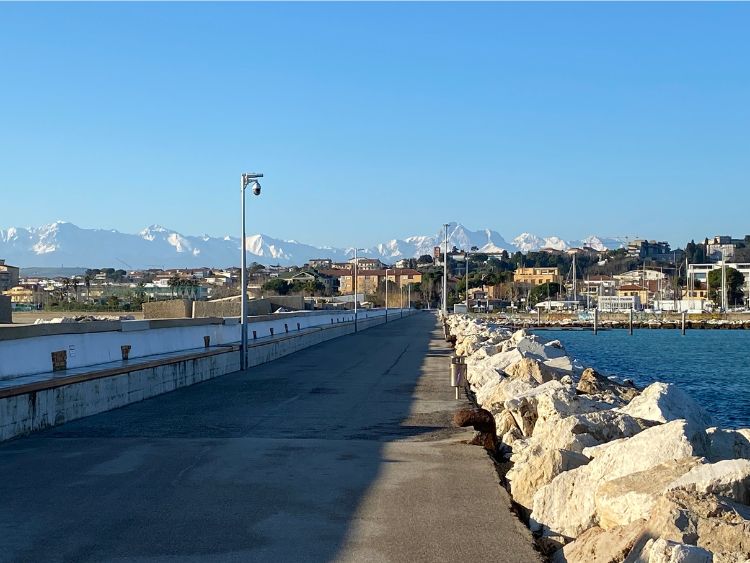
All five of the places described in this article can be reached in a day from Giulianova. This is the less obvious, but perhaps most valuable, advantage of choosing Hotel Cristallo as a base for a stay in Abruzzo: it’s not just a seaside hotel, it’s a starting point for exploring a region that has much more to offer than meets the eye from the beach. In fact, from the southern pier of Giulianova’s port, the mountain is clearly visible: the Gran Sasso massif with its Corno Grande, its highest peak.
The Hotel Cristallo is located on the Lungomare Monumentale in Giulianova Lido. It’s a 4-star beachfront hotel, open year-round. This means it’s a great base not only in summer, but also in spring, autumn, and winter: the seasons when the Abruzzo hinterland is at its best, with fewer tourists, diverse landscapes, and accessibility that becomes more challenging in summer.
The private, fully equipped beach is available throughout the beach season. The Cristallo Restaurant, serving Adriatic seafood cuisine and a reputation consistently confirmed by guest reviews, is open year-round. The hydromassage pool area, located on the panoramic solarium, is only available in the summer, while the wellness area treatments are available regardless of the season.
Those who want to combine excursions inland with the comfort of a 4-star hotel facing the sea can contact Contact the hotel directly too receive availability and personalized rates for any period of the year.
FAQ – Abruzzo to visit
1. What are the most beautiful places to visit in Abruzzo outside the coast?
The five unmissable places in the Abruzzo hinterland are the Gran Sasso and Campo Imperatore, the Rocca Calascio Castle (listed by National Geographic as one of the 15 most beautiful castles in the world), the medieval villages of Santo Stefano di Sessanio and Scanno, the Abruzzo, Lazio and Molise National Park with its Marsican brown bear, and the Stiffe Caves with their underground waterfalls.
2. When is the best time to visit the Abruzzo hinterland?
The Abruzzo hinterland can be visited year-round. Spring and autumn are the best seasons for trekking and wildlife spotting. Summer is ideal for Campo Imperatore and the higher altitudes. Winter offers skiing on the Gran Sasso and Scanno. The Stiffe Caves can be visited year-round, with a constant internal temperature of 10 ° C.
3. How long does it take to visit Rocca Calascio?
A visit to Rocca Calascio Castle takes one to three hours, including the walk from the parking lot, a tour of the castle, the church of Santa Maria della Pietà, and the village. Admission is free daily from 9:00 a.m. until sunset. It’s recommended to check weather conditions before departure.
4. How do you get to the Stiffe Caves from the Adriatic?
The Stiffe Caves are located in San Demetrio ne’ Vestini, in the province of L’Aquila. They can be reached from Giulianova in about 90 minutes by car via the A24 Rome-L’Aquila motorway, exiting at L’Aquila Est. Guided tours last about an hour. Online reservations are recommended, especially on weekends.
5. Is it possible to see the Marsican brown bear in the Abruzzo National Park?
Sightings of the Marsican brown bear in the wild are not guaranteed, but they are possible. The Abruzzo, Lazio, and Molise National Park organizes guided bear-watching excursions, especially in the morning and evening hours of spring and autumn. The estimated population is around 50 within the Park and surrounding areas. In Villavallelonga, there is a Bear Visitor Center with a semi-wild bear that can be visited year-round.
📞 +39 085 800 3780