



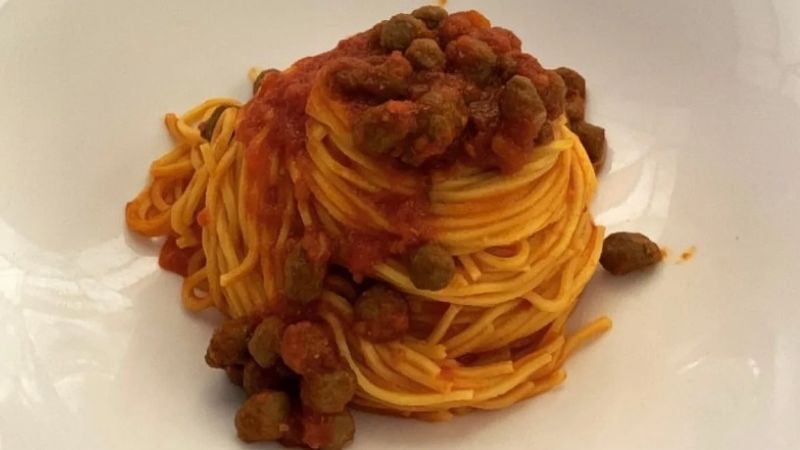
From grilled arrosticini to brodetto alla giuliese prepared in a terracotta pot, from pasta alla chitarra with meatballs to Gambero Rosso-awarded Montepulciano d’Abruzzo: eating in Abruzzo is a gastronomic experience unlike any other.
Topics covered in this article:
- Abruzzo cuisine: where sea and mountains meet.
- The great classics of the hinterland: arrosticini, pasta alla chitarra, cheeses and cured meats
- Seafood cuisine: brodetto alla giuliese and Adriatic fish
- The wines of Abruzzo: Montepulciano, Trebbiano, Cerasuolo, and Pecorino
- Cristallo Restaurant: where Abruzzo tradition meets the Giulianova waterfront
- FAQ – Eating in Abruzzo
Abruzzo cuisine: where sea and mountains meet.
Eating in Abruzzo is like being confronted with an apparent contradiction: a region overlooking the Adriatic where seafood cuisine coexists with a hinterland tradition of grilled meats, aged cheeses, and handmade egg pasta. This is n’t a contradiction; it’s the gastronomic specificity of a region with two geographical souls, bringing both to the table.
The Adriatic coast offers a straightforward seafood cuisine, with fresh fish as the undisputed star: brodetti (broths) cooked in terracotta pots, mixed fried fish, and clam soups. Travel a few dozen kilometers inland to discover a completely different culinary world: slowly grilled mutton arrosticini, Abruzzo timbale with layers of pasta, ragù, and hard-boiled eggs, aged pecorino cheese from the mountains of L’Aquila, ventricina (veal belly) from the Vasto area, and maccheroni alla chitarra (guitar-style pasta) with meatballs.
This duality-rare in a single region- is why Abruzzo’s food and wine deserves a dedicated trip, not just a holiday dinner.
The great classics of the hinterland: arrosticini, pasta alla chitarra, cheeses and cured meats
Abruzzo’s mountain cuisine boasts some dishes so distinctive that they have become regional symbols recognizable throughout Italy.
Arrosticini are the dish that best represents Abruzzo beyond its borders. These are small skewers of diced mutton, threaded onto wooden sticks, and cooked slowly over the “furnacella,” a traditional elongated grill. The meat must come from adult mutton, not lamb: the flavor is more intense, and the muscle fiber responds better to slow cooking over the embers. A perfect arrosticini has a slightly crispy exterior and a tender interior. At least twenty are needed per person, accompanied by homemade bread and red wine. The Pescasseroli, Scanno, and entire Marsica areas are the preferred areas, but arrosticini are now found throughout the region, from the villages of the L’Aquila hinterland to the restaurants along the Adriatic coast.
Pasta alla chitarra with meatballs is the first course that best represents Abruzzo’s home cooking. The chitarra is a traditional instrument, a rectangular frame with rows of parallel metal wires, on which the egg pasta dough is stretched to create square spaghetti, with a porous texture that holds the sauce exceptionally well. The meatballs are small balls of ground meat, cooked in tomato ragù. The result is a seemingly simple dish, whose quality depends entirely on the skill with which the pasta is worked and the slowness of the ragù.
Abruzzo timbale is a dish for special occasions: Christmas, Easter, and weddings. Alternating layers of pasta, meat sauce, hard-boiled eggs, peas, and cheese, it’s baked in a pan that reveals a layered interior when cut open. Every family has its own version, even a simple version with only vegetables; every grandmother has her own variation. It’s one of the hardest dishes to find in restaurants because it requires hours of preparation: when you come across it, it’s worth stopping by.
Pecorino d’Abruzzo is the region’s flagship cheese, produced from sheep’s milk throughout the mountainous region. It exists in a fresh, soft, lactic version, with its characteristic sheep’s milk aroma, and a mature version, with a firm texture and stronger flavors. Pecorino di Farindola, produced in the town of the same name near Pescara, is one of the most distinctive versions: it is curdled with pig rennet, an ancient technique that gives the cheese a unique and inimitable flavor.
Ventricina del Vastese is the most famous cured meat from Abruzzo in Italy. Unlike many other Italian cured meats, ventricina is not minced but rather cut into large pieces, mixed with sweet and spicy red peppers, wild fennel, and pepper, then stuffed into natural casings. It appears as a red, fragrant mass that is served spread on bread, not sliced. It is a product that represents the Vasto area, in the province of Chieti, like no other.
Seafood cuisine: brodetto alla giuliese and Adriatic fish
Abruzzo’s seafood cuisine is best known for its fish soup, brodetto, which is its most distinctive dish. There are three main variations along the coast: brodetto alla vastese, brodetto alla pescarese, and brodetto alla giuliese, each with its own characteristics that reflect the maritime culture of its home port.
Brodetto alla giuliese – lu vred ò tte in the Giulianova dialect- is the dish that best tells the story of Giulianova’s maritime history. It originated as a humble fishermen’s dish: the shipowner would give the fishermen the ” scafetta,” the unsold small catch, which was cleaned and washed with seawater, then cooked in a terracotta pot in strict order of firmness. The fundamental rule of traditional preparation is that the fish is never turned: the pan must be “trizzicato,” that is, shaken gently, to combine the ingredients without breaking the flesh.
Typical ingredients of brodetto alla giuliese include cuttlefish, red mullet, gurnard, monkfish, skate, scampi, and panocchie (female Adriatic octopus) with tomato, garlic, chili pepper, and extra virgin olive oil. It’s served in the same terracotta pots in which it was cooked, accompanied by toasted homemade bread for dipping in the broth.
The connection between this dish and Giulianova is so profound that during a 2010 Slow Food gathering, dedicated to a comparison of Abruzzo’s brodettos, the brodetto alla giuliese was prepared by the chef of the Cristallo restaurant in Giulianova Lido, a sign that this cuisine is not just an archival tradition, but a living and practiced gastronomy.
In addition to brodetto, Abruzzo’s Adriatic seafood cuisine includes mixed fried fish, a selection of small Adriatic fish coated in flour and fried, clam soups, grilled fresh fish, and raw fish carpaccio. The raw materials from the central Adriatic-red mullet, sole, cuttlefish, scampi, and anchovies- are of superior quality and are best served with minimal additions to avoid overpowering the natural flavor of the catch.
The wines of Abruzzo: Montepulciano, Trebbiano, Cerasuolo, and Pecorino
Abruzzo’s food and wine culture cannot be understood without its wines. The region produces some of Italy’s most highly regarded red wines, boasting a well-structured quality pyramid and growing international recognition.
Montepulciano d’Abruzzo is the region’s most representative wine and the second most widespread DOC in Italy after Chianti. The Montepulciano grape-not to be confused with Vino Nobile di Montepulciano, which is Tuscan and made with Sangiovese-has documented traces in Abruzzo since the 18th century. The wine is deep ruby red, with bold tannins, notes of red fruit and spice, and a remarkable aging potential. In the 2026 Gambero Rosso guide, Vini d’Italia, several Montepulciano d’Abruzzo wines have earned the highest Tre Bicchieri award. In November 2025, the new DOCG Casauria was also recognized, further elevating the quality pyramid of Montepulciano in a specific area of the province of Pescara.
Cerasuolo d’Abruzzo is a rosé made from the same Montepulciano grape using a rosé winemaking technique. The intense cherry red color, which gives the wine its name (Cerasuolo, from the cherry), has floral and fruity aromas and a freshness that makes it the perfect wine to pair with Adriatic fish. It’s the Abruzzo summer wine: light, fragrant, and versatile. The “Cerasuolo a Mare” wine festival in Giulianova, now in its thirteenth edition in 2026, is dedicated to this wine.
Trebbiano d’Abruzzo is the region’s flagship white wine, made from the Trebbiano Abruzzese grape. In its more traditional versions, it is a dry, refined wine with good acidity, ideal with Adriatic fish. In its more innovative versions, such as those produced with prolonged aging in terracotta amphorae by some wineries in L’Aquila, it expresses surprising complexity and depth.
Pecorino d’Abruzzo (the grape, not the cheese-same name, very different products) is the native white grape that has conquered international markets in recent years with its citrusy freshness and distinctive personality. At the 2026 Città del Vino International Wine Competition, several Pecorino d’Abruzzo wines won gold and grand gold medals before panels of international tasters from over ten countries.
Cristallo Restaurant: where Abruzzo tradition meets the Giulianova waterfront
Eating in Abruzzo in Giulianova has a consolidated reference address: the Cristallo Restaurant, inside the Cristallo Hotel on the Monumental Seafront.
It’s not a hotel restaurant in the conventional sense. It’s the establishment that guests spontaneously cite in reviews as the selling point that keeps them coming back-and which in 2010 was chosen by the Slow Food convivium of Val Vibrata and Giulianova to represent the brodetto alla giuliese in a regional competition with the brodetto of Vasto. This recognition comes from within the food and wine world, not from the hotel’s marketing.
The Cristallo Restaurant’s cuisine features Adriatic fish made with fresh, local ingredients, interpreting the Giuliano seafood tradition without overdoing it. Brodetto alla giuliese (brodetto alla giuliese) is one of the menu’s signature dishes, prepared using traditional techniques in terracotta pots. The wine list highlights Abruzzo’s DOC and DOCG wines, with a selection of Montepulciano, Cerasuolo, Trebbiano, and Pecorino that complement the dishes with a regional flair.
In autumn and spring, when the summer tourists have departed but seafood cuisine is at its best, the restaurant operates at full capacity, just like in high season, with the same care for the ingredients and the same attention to service. The Hotel Cristallo is open year-round, and so is the restaurant.
For those coming to Giulianova looking for authentic Abruzzo cuisine, Ristorante Cristallo is a solid starting point, not just for dinner, but for understanding what Abruzzo’s Adriatic cuisine truly means when you take it seriously.
Contact the property directly for availability and packages that include accommodation and meals.
FAQ – Eating in Abruzzo
1. What is the most famous typical dish of Abruzzo?
Arrosticini are the signature dish of Abruzzo: small skewers of mutton cooked on the “furnacella,” a traditional elongated grill. They originate from the mountainous hinterland-Marsica, Pescasseroli, and the L’Aquila area-but are found throughout the region. They are always eaten in large quantities, at least twenty per person, accompanied by toasted bread, sometimes drizzled with excellent Abruzzo extra virgin olive oil (bruschetta), and red wine.
2. What is brodetto alla giuliese and where can you eat it in Giulianova?
The giuliese-style broth, “Lu vred ò tte” in dialect is Giulianova’s typical fish soup, cooked in a terracotta pot with fresh Adriatic fish, tomato, garlic, and chili pepper. The traditional rule is to never turn the fish during cooking, but to “trizzica” the pan. It’s served in seafood restaurants along the Giulianova seafront, including the Cristallo Restaurant at the Hotel Cristallo.
3. What are the typical Abruzzo wines to pair with local dishes?
The main Abruzzo DOC wines are Montepulciano d’Abruzzo (red, ideal with arrosticini and pasta with ragù ), Cerasuolo d’Abruzzo (rosé, perfect with fish), Trebbiano d’Abruzzo (white, with fried foods and broths), and Pecorino d’Abruzzo (fresh and aromatic white, with seafood appetizers). In 2025, the new Casauria DOCG was recognized, adding a further level of quality to the Montepulciano pyramid.
4. Where can you eat the best arrosticini in Abruzzo?
The best arrosticini are found in the L’Aquila hinterland, in Pescasseroli, Scanno, Sulmona, and the Marsica area, where the tradition of mutton is most deeply rooted. On the Adriatic coast, many restaurants offer them as an appetizer or main course. The ideal pairing is with Montepulciano d’Abruzzo DOC.
5. Is Abruzzo cuisine also suitable for those who don’t eat fish?
Yes. Abruzzo cuisine is one of the most complete in Italy in terms of variety. The hinterland offers a tradition of meat, arrosticini, lamb chops, grilled meats, aged cheeses such as Pecorino d’Abruzzo and Farindola, cured meats such as Ventricina del Vastese, egg pasta dishes such as chitarra with meatballs and timballo abruzzese. Those who don’t eat fish in Abruzzo are spoiled for choice.
📞 +39 085 800 3780